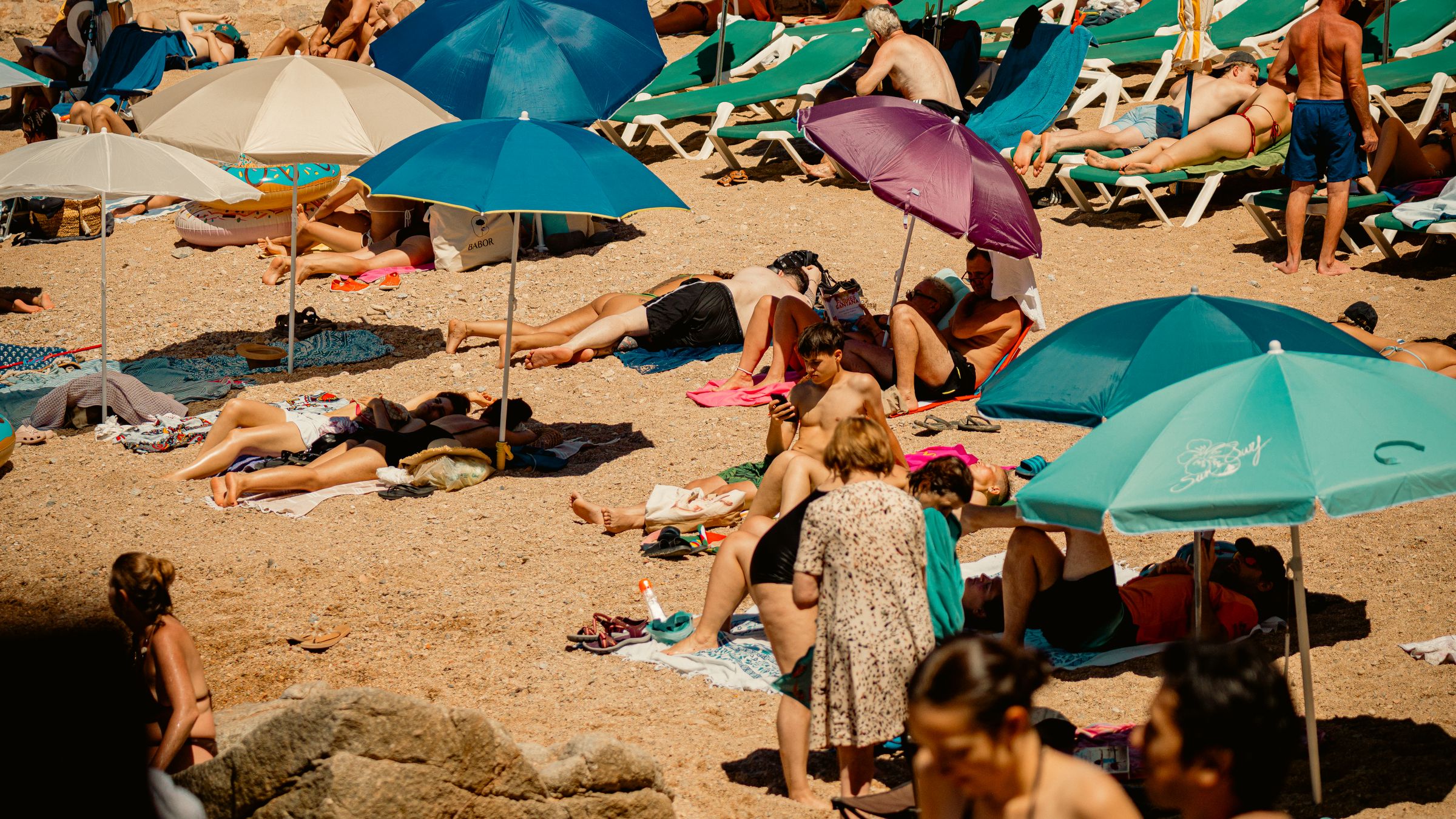
Two Salous share the same street plan. One holds several times its own population, runs its bars until four in the morning and cannot park a car near the front. The other is a Catalan town of under thirty thousand people with a long empty beach. Both are real. They never appear at once.
Which one you meet depends on the month on your booking, and on little else.
How the year is shaped here
Salou runs on a season rather than a calendar. Hotels begin reopening around Setmana Santa — Easter week — and most have closed again by early November. Inside those seven months the resort builds through spring, peaks hard in August, then empties over three weeks in October.
Weather is the straightforward part. Summer days sit in the high twenties and touch thirty; June and September hold a comfortable mid-twenties; April and October give low twenties and a jacket after sunset; winter afternoons hover in the mid-teens. Rain is scarce in summer and mostly arrives in autumn.
Locally the switch has a date. On the night of 23 June, Sant Joan, bonfires and fireworks go up along the Catalan coast and the sand fills with people who are not, for once, on holiday. After that, it is summer.
July and August, at full volume
August is the month most people picture and the month this almanac would talk you out of. Three problems arrive together, and they compound.
Heat, first. High twenties is pleasant on sand with water forty metres away, much less so walking up Carrer Carles Buïgas at two in the afternoon, and August nights stay muggy enough that working air conditioning stops being a nicety. Crowds, second: Spain largely takes August off and northern European school holidays land on top, so domestic and foreign peaks stack instead of taking turns. Price, third — a May room costs roughly double, and the cheap flights stop being cheap.
July is a softer version of the same thing: hot, busy and expensive, but the first fortnight is noticeably calmer than anything after the twentieth.
Fairness demands the other half. Peak season is the only time the resort runs at full strength: every bar open, the Font Lluminosa doing its evening water-and-light show, the theme park staying open late. If a holiday depends on that — teenagers, a large group, a first trip built around the rides — then August is not a mistake but the point. Go in early July if you can.
August is the only month when Salou is completely itself. That is also, unavoidably, the problem with August.
May, June and September
Three months do it better, and regulars are not loud about it.
September is the strongest and easiest to defend. Sea temperature sits at or near its annual high, air is still mid to high twenties, and from the second week the families tied to school terms have gone home. Prices follow within days. For anyone whose dates are not set by a school office, the middle fortnight of September is the best two weeks in the Salou year.
June works on different terms. Days are at their longest, the resort is fully open, and the crowd is thinner than the weather deserves. Its weakness is the water, which lags badly behind the air.
May is the value month: low twenties by day, light evenings, a deserted headland path around the coves, and rooms at their cheapest inside the open season. Swimming is possible and briefly startling. Lying on the beach is not.
September's weakness is rain. Autumn on this coast delivers water in short violent bursts rather than drizzle, and one afternoon storm can drop more than the whole of July. Storms clear within hours, but still take a beach day out of a fortnight; keep an indoor plan in reserve.
Why the sea is warmer in September than in June
Newcomers get caught by this every year. Air and water do not peak together; the gap runs to about two months.
Water holds heat far better than air, and sheds it far more slowly. The sea here is coldest, roughly 13°C, in February and March — well after the coldest air. It climbs slowly: about 15°C in April, near 18°C in May, which is swimmable for perhaps ninety seconds. Only by mid-June does it reach the low twenties. Peak comes in August at around 25°C, September holds most of that at about 24°C, and October settles near 21°C — still warmer than any June day.
A local wrinkle sharpens the effect. The main beach shelves very gently, so the top metre of water over that sand warms faster than on a steeper coast. The coves round the headland are deeper and often shaded by pine, and run a degree or two behind all season.
Practical upshot: if swimming matters more than sunbathing, the back half of the season beats the front half at any equivalent air temperature.
April and October: fine weather, half a resort
Both shoulder months sell themselves on air temperature, then quietly withhold the resort.
April offers low twenties, green hills behind the coast and a beach you can walk end to end without stepping over anybody. What it withholds is the swim — at 15°C the sea is a paddling proposition. Setmana Santa breaks the quiet for one week, busy and priced to match, then everything drops back.
October reverses those terms. Water is still warm, warmer than visitors expect, and late-afternoon light is the best of the year. Closures are the catch: the aquatic park has shut for the season, the theme park moves onto a thinner autumn schedule around its Halloween run, bars pull in their terraces, and by the final week the strip is visibly winding down. Calendars change annually, so check what the park is actually running.
Anyone free to travel outside school holidays should treat the Salou year as two windows rather than one season: mid-May to the end of June, and the first three weeks of September. Both give warm days, an open resort and none of the August arithmetic. Families tied to school dates do better in the first half of July, before the continental holidays begin — see the note on small children.
Winter, when the resort switches off
Be blunt about this one: a winter package to Salou will find most of what people come here for closed.
Between November and March, in rough terms:
- a large share of the hotels take no bookings at all;
- most of Carrer Carles Buïgas, the nightlife street, is shuttered;
- beach bars and lounger concessions are gone from the sand;
- the water park is closed, and the theme park takes its winter break after Christmas;
- the Font Lluminosa is dark most evenings.
Underneath all that sits a town, and the town is better than its reputation. Afternoons reach the mid-teens and the promenade belongs to residents again. Ordinary restaurants price for residents, and the weekly market is a market rather than a souvenir stall. Passeig Jaume I and its villas look their age instead of their season, Torre Vella sits in its gardens without a queue, and the headland path is cool enough to walk properly.
Winter makes a decent short break for anyone wanting mild walking, quiet restaurants and an empty beach. It makes a poor holiday for anyone expecting the resort in the brochure. Both are sold under the same place name at similar prices, which is how people end up on a closed strip in February.
Season by season
| Period | Air by day | Sea | Character | Catch |
|---|---|---|---|---|
| Nov–Mar | mid-teens | 13–15°C | Quiet Catalan town | Most of the resort closed |
| April | low 20s | about 15°C | Reopening, empty sand | Too cold to swim; Easter spike |
| May | low 20s | about 18°C | Open, cheap, calm | Sea still bracing |
| June | mid 20s | low 20s | Longest days, moderate crowds | Water lags the weather |
| July–Aug | high 20s to 30 | 24–26°C | Full volume | Heat, crowds and peak prices at once |
| September | mid to high 20s | about 24°C | Warm sea, thinning crowd | Autumn downpours |
| October | low 20s | about 21°C | Warm water, closing down | Attractions on reduced hours |
None of these months is wrong, exactly. They produce different holidays sold under one name, and the gap between what a month delivers and what a brochure implies causes most of the disappointment on this coast. Choose on the sea and take September; on price, May or October; on noise, July. Seasonal dates shift every year — the Salou tourist board and the town hall publish current ones, and the regional tourism office covers the coast either side.