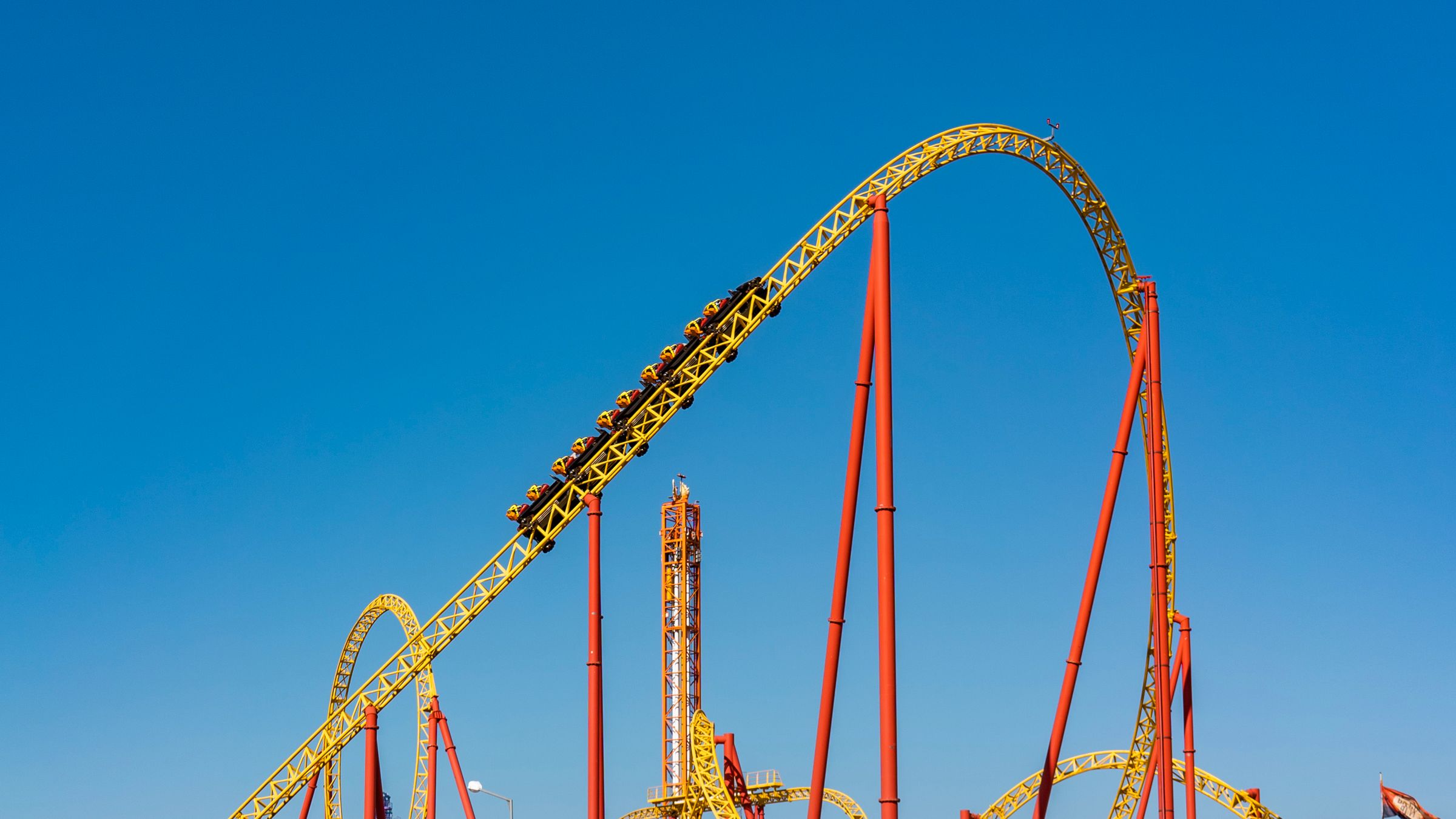
Most theme parks are somewhere you drive to. This one is at the end of the street.
PortAventura opened in 1995 on flat farmland behind Salou and Vila-seca, and the resort has been arranging itself around that fact ever since. Hotels quote their walking time to the gates. Local buses thicken in that direction through the summer. A good share of the families lying on Platja de Llevant in July are having a rest day between two park days. Treating a visit as a proper excursion — something you set aside, hire a car for, make a production of — misreads the geography badly.
Closer than most people expect
From the middle of Salou the main gate is roughly three kilometres away. From the inland edge of the resort, up where Carrer Carles Buïgas runs out of hotels and hands over to roundabouts, it is nearer two.
So it is a walk, and in May or October a decent one: twenty-five to thirty-five minutes on flat ground, pavement almost the whole way, signed once you are close. At three in the afternoon in August, carrying towels and towing a five-year-old, it is a different proposition entirely. Judge the walk by the month, not by the map.
Anyone whose holiday is mostly about the park should weigh this when choosing a bed. Rooms at the inland, western end of the resort put the gates within a genuine stroll; the far end of Llevant and Cap Salou do not, and the fix is a fare twice a day.
Three ways to the gates
- On foot, from the inland half of Salou — free, flat, and pleasant outside high summer.
- By bus, from stops along the main streets — under ten minutes, running frequently through the season and much less so outside it. Routes are operated by the same regional company that handles the airport coaches, and timetables are published by Plana.
- By train, to the station that carries the park's name and stands at the edge of the site, a few minutes' walk from the entrance.
That third one is the option visitors overlook. Since the old coastal alignment through Salou was taken out of passenger service, the PortAventura stop has effectively become the resort's railway station too, which makes it useful in both directions — out to Cambrils, Reus or Tarragona as easily as in to the park. Regional services are listed by Rodalies de Catalunya. More on local movement generally sits in the note on getting around.
Not one park but three
Here is the thing worth understanding before any money changes hands: PortAventura World is three separately gated, separately ticketed attractions sharing one site and one car park. People buy what they assume is the ticket and find at the barrier that it covers one of the three.
| Gate | Opened | What it is | Realistic time |
|---|---|---|---|
| PortAventura Park | 1995 | Six themed areas, the big coasters, the shows | A full day, minimum |
| Ferrari Land | 2017 | Small, Ferrari-branded, one enormous ride | Two to three hours |
| Costa Caribe | Later addition | Slides, wave pool, lazy river | Half a day |
Ferrari Land is the awkward one to advise on. It is genuinely compact — most of it is walkable in an afternoon — and it carries a supplement on top of the main ticket. Whether that earns its keep comes down to a single question: does anyone in your party want to be fired well over a hundred metres into the air at close to 180 kilometres an hour? Red Force does exactly that, and most of the queue is for it alone.
What the queues are for
The original park divides into six themed areas. Mediterrània takes the entrance, a fishing-village pastiche with a lake at its centre; from there the paths lead into Far West, México, China, Polynesia, and SésamoAventura, which belongs to the smallest visitors.
Dragon Khan has been in the China area since opening day — eight inversions, a world record when it was built, and still the shape that defines the horizon when you look inland from Salou. Shambhala arrived beside it in 2012: a hyper-coaster, something over seventy metres at its highest point, with a drop into a trench that takes the ground out from under the track. Between them they produce most of the park's noise and nearly all of its photographs.
Furius Baco launches out of Mediterrània in under four seconds and divides opinion sharply. Hurakan Condor drops out of the top of México. Far West holds the wooden coasters and the log flume; Polynesia is where you go to get wet on purpose. On a hot day the water rides carry longer queues than anything with inversions.
If the children are small
SésamoAventura is the answer, and it is better than the equivalent corner of most parks: scaled-down rides, a small coaster of its own, real shade, and characters that children under six actually recognise. Two or three hours disappear there without complaint.
The rest of the park is not wasted on them either. Rapids, flume and the Polynesian water rides run to height limits a confident six-year-old will clear, and the shows — parades, the evening set piece — need no minimum height at all. Measure everyone at home before you go. Discovering a height limit at the barrier, after forty minutes of queue, is the single most reliable way to ruin an afternoon.
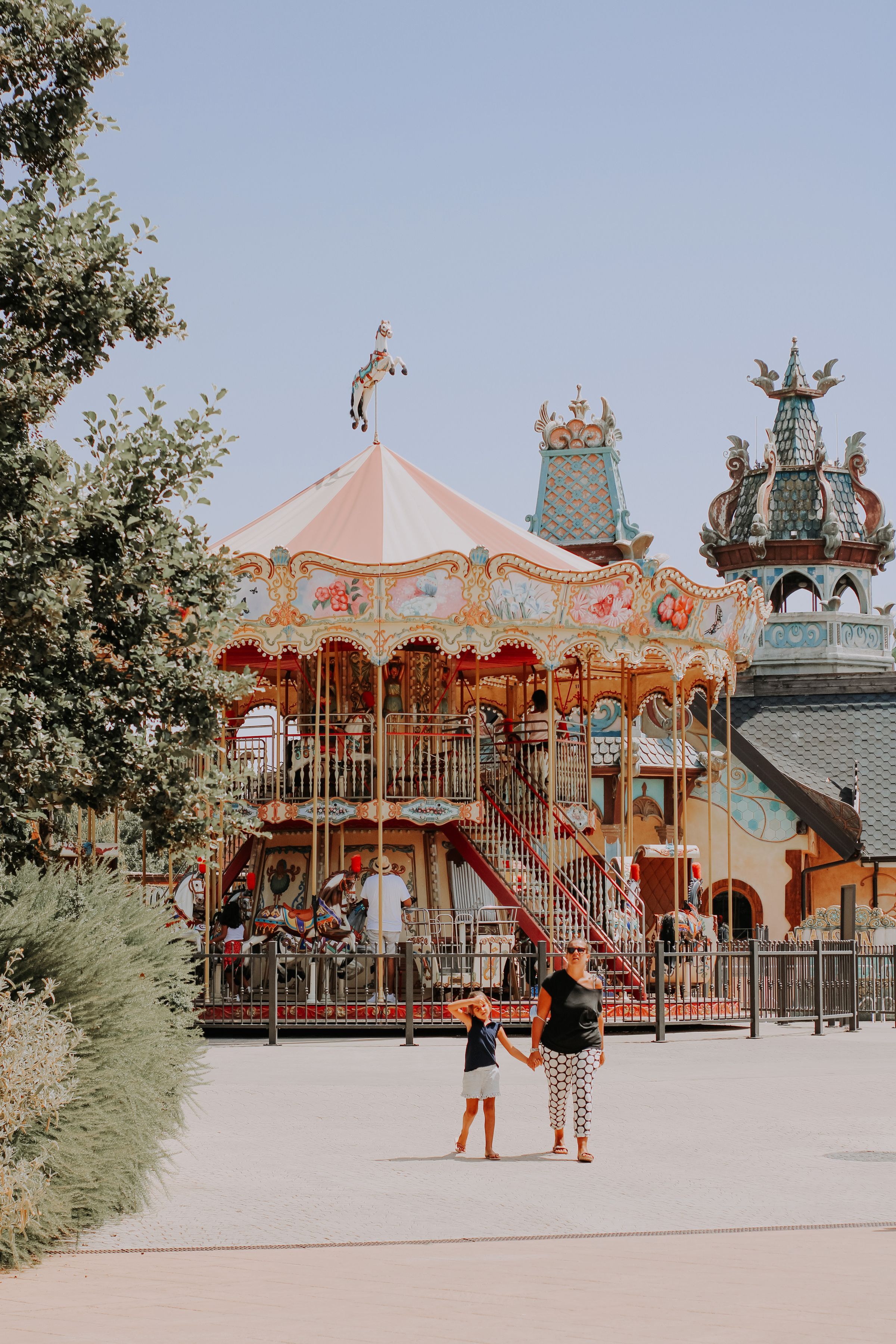
Families travelling with a toddler rather than a school-age child should read the note on Salou with small children first. For under-fours the beach usually wins, and the park keeps.
Building a day around the heat
Through July and August the park opens in the morning and stays open late into the night, and those two ends of the day are not remotely the same experience. Midday means full sun on open queue lines with very little shade. Nine in the evening means warm air, lit-up rides, and lines that have quietly halved.
A pattern that works: go in during the late afternoon, when the coach parties are wilting and the temperature has come off its peak; ride until the light goes; stay for the closing show. Afternoon-entry tickets cost meaningfully less than a full day and, in high summer, buy you the better half of it. Families who arrive at opening time are frequently finished by two and asleep beside a hotel pool by four.
Everyone leaves at once. The last twenty minutes of a park day are spent in a car park, a taxi queue or a bus line, and only one exit is entirely under your own control. If you walked in, walk out — the road back into Salou is lit, level and busy with other people doing the same thing.
Costs, crowds and the water park
August is the honest problem. Waits on the headline rides run past an hour and sometimes well past it, and a family of four can spend the larger part of a nine-hour day standing still in the sun. The park is no less good in August; there is simply a great deal less of it per hour, and children feel that arithmetic before adults admit to it.
Then there is the money. Three gates means three tickets, and the way they stack — a base ticket, a supplement for Ferrari Land, a separate ticket for the water park, multiplied by four people and then by however many days — climbs faster than anyone expects while browsing at home. Multi-day and multi-park combinations soften the total; they do not make it small. Decide which of the three you genuinely want before you arrive, rather than at a ticket window with a queue behind you.
Costa Caribe is usually where that decision falls. On a genuinely hot afternoon it is a relief, and the bigger slides are properly good. But Salou has two long beaches and a sea at much the same temperature, both free and ten minutes from most hotels — see the note on Platja de Llevant. Unless the children have specifically asked for the slides, the water park rarely justifies a full day out of a week.
Opening calendars, show times and ticket combinations all change by season and are published by the resort itself. Check them close to your dates. Outside the summer months the park does not open every day, which catches out a surprising number of people who assumed a place this size never closes.